
Methuselah: The World’s Oldest Living Tree & Other Ancient Giants

Updated: Oct 31, 2025
Unveiling Methuselah: The Story of the World’s Oldest Tree and 10 Other Timeless Giants
If you could imagine a living tree as old as the pyramids of Egypt but that’s also seen the invention of the iPhone, what do you think it would look like? In the secluded White Mountains of California, an ancient bristlecone pine named Methuselah stands as the world’s oldest known tree. With an estimated age of 4,850 years, Methuselah has silently witnessed the passage of time, enduring countless climatic changes and historical events. But Methuselah is not alone in its ancient grandeur. Across the globe, other ancient trees like Llangernyw Yew and the Olive Tree of Vouves have similarly withstood the test of time. In this blog, we explore the fascinating stories of Methuselah and 10 other remarkable trees that have become timeless guardians of our planet’s natural heritage.
All About Methuselah: The Ancient Bristlecone Pine
Methuselah, a Great Basin bristlecone pine (Pinus longaeva), stands as a monument to time. This ancient sentinel has borne witness to nearly five millennia of history, from the construction of the Great Pyramids to the rise and fall of empires. But what makes Methuselah truly remarkable is not just its age, but the stories and secrets it holds within its weathered branches.
The Discovery of Methuselah
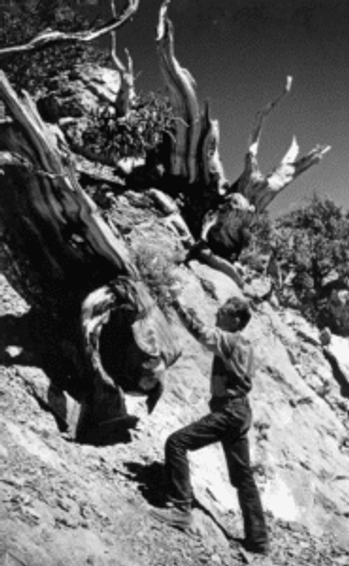
Methuselah was discovered in the 1950s by Edmund Schulman, a dendrochronologist (a scientist who studies tree rings to uncover various aspects of the environment and history – so aka a tree detective). Beginning in 1939 and for the rest of his life, Schulman spent every summer looking for the oldest living trees in the United States. At the end of the summer of 1953, Schulman left Sun Valley, Idaho, where he had located a 1,650-year-old limber pine(Pinus flexilis) the prior year. On his way home, he detoured to the White Mountains to view the rumored old pines.“Often such rumors had turned out to be unfounded,” he later observed. “But not this time!”[1]
Schulman’s discovery was groundbreaking, revealing that bristlecone pines could live for thousands of years. That summer, Schulman found the ideal conditions to break the B.C. Barrier: the farthest limit of the dry forest edge, calcareous rock outcroppings, and minimal rainfall. In this area, he found a tree that was 4,600 years old, the oldest living tee, and called it Methuselah. The tree was named after the biblical Methuselah, who is said to have lived 969 years, symbolizing extreme longevity. However, long before Schulman’s groundbreaking discovery, Native Americans, particularly the Paiute tribe, were familiar with these ancient trees.
Stories and Legends Surrounding Methuselah from Native Americans
Methuselah’s age and resilience have inspired numerous stories and legends. Native American cultures have revered bristlecone pines for centuries, incorporating them into ceremonies that honor the earth’s cycles and the interconnectedness of life.

The Paiute tribe of Native Americans were the first humans to enter the White Mountains, which are home to the ancient bristlecone pine Methuselah, around 4,000 years ago. They returned with stories about the trees’ oddly shaped wood, which could be used to build shelter but not burned easily.[2]
Additionally, while the Shoshone tribe’s reverence for the bristlecone pine isn’t as well-documented as the Paiute’s, they would use the resin of the trees for medicinal purposes, believing it had healing properties that could cure various ailments. Specifically, they used a poultice of heated pitch from bristlecone pine on sores and boils.[3]
In various Native American traditions, trees like the bristlecone pine are considered symbols of endurance and longevity. The twisted and gnarled trunks of these ancient trees are often seen as manifestations of their enduring spirits. These trees, living for thousands of years, are viewed as guardians of the mountains, embodying the resilience and strength that comes from surviving in harsh conditions.
Why is Methuselah So Old?
Methuselah’s remarkable age can be attributed to several factors. The harsh conditions of the White Mountains—characterized by cold temperatures, high winds, and nutrient-poor soil—actually contribute to the tree’s longevity. These conditions slow down the growth rate, resulting in dense, resin-rich wood that is resistant to insects, fungi, and decay. Furthermore, the tree’s ability to go into a state of dormancy during unfavorable conditions helps it survive through centuries of environmental changes.
Conserving Ancient Trees: Methuselah and Beyond
The exact location of Methuselah is kept secret to protect it from potential damage, ensuring that this ancient tree remains undisturbed. Hidden somewhere along the 4.5-mile (7.2 kilometers) Methuselah Trail in the White Mountains of Inyo National Forest in California, the tree’s precise whereabouts are undisclosed, and officials avoid releasing actual photos of it. Preserving this secrecy is crucial to keep overly enthusiastic tourists away from Methuselah and similar trees. However, tourists are not the only threat. The most severe drought in the West in over 1,200 years has killed bristlecone pines near Methuselah, while bark beetles are attacking other ancient bristlecones.[4] Human-induced climate change could create a “perfect storm” of threats to these trees, with extreme heat, drought, and an increased risk of forest fires.
Methuselah’s story is indeed extraordinary, but it is not the only ancient tree that has stood the test of time. Around the world, there are other remarkable trees that have similarly weathered millennia. Let’s journey across the globe and explore the tales of these 10 other timeless giants, each with its unique history and significance.
Other Ancient Living Trees Around the World
Sarv-e Abarqu (Zoroastrian Sarv) – A 4,000-year-old cypress tree in Iran, also known as the Abarqu Cypress, is one of the oldest living organisms in Asia.
Llangernyw Yew – An ancient yew tree located in the churchyard of Llangernyw village in North Wales, estimated to be around 4,000-5,000 years old.
Olive Tree of Vouves – Located on the Greek island of Crete, this ancient olive tree is at least 2,000 years old, with some estimates placing it over 3,000 years old.
Jomon Sugi – A cryptomeria tree located on Yakushima Island, Japan, estimated to be between 2,170 and 7,200 years old.
Alerce (Fitzroya cupressoides) – Found in Chile, some specimens of this tree are over 3,600 years old.
Patriarca da Floresta – A giant Cariniana legalis tree in Brazil, estimated to be over 3,000 years old.
Chestnut Tree of One Hundred Horses – Located on Mount Etna in Sicily, this ancient chestnut tree is believed to be between 2,000 and 4,000 years old.
Jaya Sri Maha Bodhi – A sacred fig tree in Anuradhapura, Sri Lanka, planted in 288 B.C., making it over 2,300 years old.
Alerce Milenario – A Fitzroya cupressoides tree in Chile’s Alerce Costero National Park, estimated to be around 3,646 years old.
Senator (Pond Cypress) – Once one of the oldest and tallest cypress trees in the United States, estimated to be around 3,500 years old before it was destroyed by fire in 2012.
Stand For Trees: Protecting Our Timeless Giants
These ancient trees are more than just biological marvels; they are living monuments to the resilience and beauty of nature. Protecting these natural wonders is essential to preserving our planet’s history and biodiversity for future generations. Beyond their majestic presence, these trees provide invaluable insights into our planet’s climatic and environmental history. Through the study of their growth rings and survival mechanisms, scientists learn about past climate conditions, ecological changes, and the impacts of human activity over millennia.
By learning about and supporting conservation efforts, we can ensure that these timeless giants continue to stand as guardians of our natural heritage.
At Stand For Trees, we’re dedicated to protecting the world’s most precious forests. Through our partnership with Wildlife Works, your support helps keep tropical forests standing, safeguards endangered wildlife, and supports the communities who call these forests home.
By acting now, you’re helping to preserve biodiversity, fight climate change, and empower forest communities around the world.

References:
[1]
[2]
[3]
[4]
[/vc_column_text][/vc_column][/vc_row]


The story of Methuselah and the world’s other ancient trees is a fascinating reminder that lasting through change requires more than simply surviving. These remarkable trees have endured shifting climates, changing landscapes, and generations of human history. The article does an excellent job of highlighting how resilience, adaptation, and longevity can shape something that continues to thrive over thousands of years. Interestingly, those same ideas can also be considered when looking at how organizations are built, managed, and sustained over time.
Just as an ancient tree depends on a strong foundation, a business needs clear foundations to support long-term growth. This connects naturally to management by objectives MBO, where organizations establish clear goals and connect individual responsibilities with broader business…
I always plan my routes through New Jersey ahead of time because state enforcement is quite strict. Weigh station operating hours on major corridors like Interstate 78 or Interstate 80 often change without much notice. If you haul commercial freight, running into an active scale with minor paperwork issues or weight compliance problems causes real delays. I usually verify location details and operational status before rolling out. Checking a resource like weigh station in new jersey helps confirm where active scales sit and what rules apply on specific highways. It keeps the day predictable and reduces stress around DOT inspections. Having clear information upfront is simply the most rational way to keep moving efficiently.
xx88 khiến mình có thói quen kiểm tra phần bảo mật trước khi trải nghiệm sâu hơn các khu giải trí. Mình chú ý đến việc nền tảng đề cập những chứng nhận như GEOTRUST và iTech Labs bên cạnh PAGCOR, MGA. Sau đó mình thử chuyển qua khu bắn cá để xem trải nghiệm có liền mạch với phần còn lại hay không. Nhiều chủ đề được thiết kế theo phong cách đại dương, kết hợp đồ họa 3D, hiệu ứng chuyển động và âm thanh sống động. Mình thấy việc kiểm tra từ yếu tố bảo mật rồi mới quan sát nội dung giúp đánh giá hệ thống toàn diện hơn, thay vì chỉ nhìn vào số lượng trò…
TN88 làm mình quan sát kỹ hơn cách các khu vực hỗ trợ được bố trí bên cạnh phần nội dung chính. Mình thường muốn tìm đúng nơi cần thiết mà không phải rời khỏi hành trình quá lâu, nên vị trí của những phần này khá quan trọng. Khi đang chuyển giữa Casino và Nổ hũ, khu vực hỗ trợ vẫn có thể được nhận biết như một chức năng riêng thay vì lẫn với các lựa chọn giải trí. Sau khi xem thông tin cần thiết, việc quay lại các phần trước cũng khá dễ định hướng. Với mình, kiểu bố trí này giúp một phiên sử dụng có nhiều mục đích nhưng không bị rối, vì mình hiểu…
xx88 là khu vực tôi tập trung đánh giá vào cách phân loại và hiển thị thông tin khi có nhiều nhóm xổ số khác nhau. Tôi thử mở từng danh mục, xem nội dung bên trong rồi quay lại danh sách chính để quan sát khả năng ghi nhớ vị trí. Nếu các nhóm được phân chia bằng tên gọi và bố cục dễ nhận biết thì tôi có thể tìm đúng nội dung nhanh hơn mà không cần mở thử từng mục. Tôi cũng chú ý đến cách những thông tin về thời gian, trạng thái và dữ liệu liên quan được đặt trên màn hình, vì thứ tự hiển thị ảnh hưởng trực tiếp đến khả năng đọc.…